1

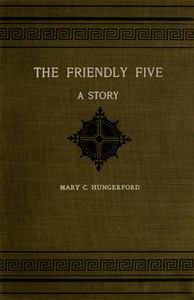
The Friendly Five: A Story — Context and Discussion
(0 User reviews)
326
Project Gutenberg
2019
Not confirmed
Orphans -- Juvenile fiction; Conduct of life -- Juvenile fiction; Friendship -- Juvenile fiction; Kindness -- Juvenile fiction; Students -- Juvenile fiction; Youth -- Conduct of life -- Fiction; Teasing -- Juvenile fiction; Awards -- Juvenile fiction
Readers of public-domain and historical texts
Project Gutenberg digital edition
en
Edition facts
Words
57,738
Reading time
252 min
Text sections
39
The catalog record for The Friendly Five: A Story — Context and Discussion provides practical reading context through 57,738 words, 4 hr 12 min estimated reading time, and 39 detected text sections.
The text analysis averages about 20.2 words per sentence, while the detected sections provide another way to judge how the source is divided.
Project Gutenberg metadata also associates the work with “Orphans -- Juvenile fiction,” connecting these edition facts with the source record’s subject description.
Source:
Project Gutenberg record #58751
Mary C. Hungerford's 1891 school story follows orphaned Marion Stubbs as she navigates friendships and moral lessons at Coventry Institute, with a narrative voice that shifts from brisk dialogue to reflective passages, and a pace that alternates between everyday routines and sudden adventures.
Editorial Edition Score
4.8/5
★★★★★
★★★★★
Calculated from edition completeness, EPUB availability, text structure and catalogue metadata. Not a user rating.
How this score is calculated
- Description quality20 pts
- Title & short description10 pts
- Source metadata20 pts
- Text length15 pts
- Chapters / structure15 pts
- EPUB file integrity20 pts
Total of 100 points, scaled to a 2.5-5.0 range. Editions with an empty description or a missing EPUB file are not scored.
Edition quality
Public-domain source text
Read the source text
The source text is kept in the dedicated reader, separate from this catalogue record and its commentary.
From its opening scene, The Friendly Five: A Story establishes a narrative voice that is both brisk and gently instructive. The first chapter, “Mr. Bellamy’s Offer,” begins with a matter-of-fact description of the Coventry Institute’s closing day: no examinations, no graduation exercises, only a sermon from the principal. The prose moves quickly through the girls’ whispered speculation about a visitor, then slows to describe the “small old-fashioned hair-cloth sofa” that replaces the principal’s chair. This shift in pace—from rapid summary to deliberate detail—recurs throughout the excerpts, signaling moments of significance.
Hungerford’s narrator often steps back to offer moral commentary, as when a character’s “bright face” and “happy sparkle” are noted without her own awareness. The voice is consistently warm but never sentimental, and the pacing varies between the quick exchanges of schoolgirl dialogue and longer, reflective paragraphs that dwell on a character’s inner state.
A Voice That Alternates Between Observation and Instruction
The narrator of The Friendly Five frequently shifts from reporting action to offering a quiet moral gloss. When Marion receives her first letters, the text notes that she “had often envied the girls when they clutched their letters from home”—a small observation that reveals her longing without melodrama. The narrator’s tone is consistently measured, even during tense moments, and the moral lessons are woven into the story through dialogue rather than direct preaching.
For instance, Mr. Bellamy’s parable about the king’s servant is presented as a story within the story, and its application to Marion’s own situation is left implicit. The narrative voice trusts readers to connect the dots, a technique that gives the moralizing a lighter touch than in many contemporaneous children’s books. The voice also varies its register: formal when describing the school’s routines, more colloquial in the girls’ conversations, and lyrical in passages about nature or emotion.
Pace as a Tool for Emphasis and Contrast
Hungerford controls pace by alternating between compressed summary and expanded scene. The opening chapter covers an entire school day in a few paragraphs, then slows to render the arrival of Mr. Bellamy in detail: the removal of the chair, the revelation of the sofa, the girls’ whispered speculation. This pattern repeats throughout the excerpts. In Chapter XX, the arrival of the mail-bag is summarized quickly—“the number of letters was greatly reduced”—but the moment Marion receives her own letters expands into a full scene, complete with Mr. Eaton’s teasing and Mrs. Abbott’s reassurance.
Later, a sleigh ride with Mr. Bellamy moves from brisk action to a quiet, almost meditative passage where he speaks softly “looking away into the soft cloud-banks.” The pace slows to match the reflective mood. These shifts are not arbitrary; they direct attention to emotional turning points. The faster passages convey the ordinary flow of school life, while the slower ones mark moments of growth or connection.
Recurring Details That Anchor the Narrative
Certain small details recur across the excerpts, creating a sense of continuity. The “high fence” around the school is mentioned twice, once in the sleigh-ride scene and once in an earlier passage, subtly reinforcing the enclosed world of the institute. The “green-covered library-desk” and “hair-cloth sofa” from the opening reappear in the reader’s memory when later scenes take place in the same room.
Character tags also repeat: Marion’s “big, honest gray eyes” are noted in one scene, and her lack of experience with letters is emphasized in another. These repeated details build a consistent portrait without heavy exposition. The narrative also returns to the motif of service—washing dishes, running errands—as a measure of character. Mr. Bellamy’s parable about the king’s servant makes explicit what the story demonstrates: that humble tasks can be noble when done for love. The recurrence of this idea gives the book a thematic coherence that the episodic plot might otherwise lack.
Readers will find that The Friendly Five rewards attention to its quieter passages, where the narrative voice softens and the pace slows. The story’s moral framework is built through these moments rather than through overt sermonizing. Pay particular notice to how Hungerford uses the school’s routines—mail delivery, lessons, holidays—as a backdrop against which small acts of kindness gain significance. The book’s structure, with its thirty-four short chapters, invites reading in brief sittings, but the cumulative effect of its carefully placed details is best appreciated in longer stretches.
Marion’s quiet striving at Coventry reminded me how much a single friendship can anchor a lonely childhood—the same steadying hand I felt following those two young travelers into the Congo’s unknown. There’s a particular tenderness in old adventure stories, that mix of cautious steps and unexpected bravery. The Boy Travellers on the Congo Adventures of Two Youths in a Journey with Henry M. Stanley "Through the Dark Continent" — Context and Discussion holds that same warmth, though its rivers run darker and wilder.
There are no reviews for this eBook.
There are no comments for this eBook.
Reader reflection
What was your reading experience?
Capture what you thought, learned, and would like to remember.
Your progress
0
/
10
2
How did the book work for you overall?
3
Is this a title you would suggest to others?
4
How much effort did this book require?
5
Did anything about the book feel genuinely new?
6
How would you describe its reading pace?
7
Did you relate to its people, ideas, or situations?
8
What was the strongest part of the book?
9
What changed or sharpened your thinking?
10