1

Billy Whiskers in France — A Closer Reading
(0 User reviews)
1453
Project Gutenberg
2021
Not confirmed
Dogs -- Juvenile fiction; Goats -- Juvenile fiction; World War, 1914-1918 -- Juvenile fiction; Cats -- Juvenile fiction; United States. Army -- Juvenile fiction; France -- Juvenile fiction
Readers of public-domain and historical texts
Project Gutenberg digital edition
en
Edition facts
Words
41,948
Reading time
183 min
Text sections
25
The catalog record for Billy Whiskers in France — A Closer Reading provides practical reading context through 41,948 words, 3 hr 3 min estimated reading time, and 25 detected text sections.
The text analysis averages about 18.9 words per sentence, while the detected sections provide another way to judge how the source is divided.
Project Gutenberg metadata also associates the work with “Dogs -- Juvenile fiction,” connecting these edition facts with the source record’s subject description.
Source:
Project Gutenberg record #65898
In this 1919 children's adventure, Billy the goat and his cat friend Button navigate World War I France, uncovering spies and dodging bombs. The narrative blends animal antics with wartime tension, as seen in Button's attack on saboteurs and Billy's homesick reflections on crossing the submarine-infested Atlantic.
Editorial Edition Score
4.9/5
★★★★★
★★★★★
Calculated from edition completeness, EPUB availability, text structure and catalogue metadata. Not a user rating.
How this score is calculated
- Description quality20 pts
- Title & short description10 pts
- Source metadata20 pts
- Text length15 pts
- Chapters / structure15 pts
- EPUB file integrity20 pts
Total of 100 points, scaled to a 2.5-5.0 range. Editions with an empty description or a missing EPUB file are not scored.
Edition quality
Public-domain source text
Read the source text
The source text is kept in the dedicated reader, separate from this catalogue record and its commentary.
Billy Whiskers, a goat with a talent for trouble, opens the story lying in an American camp in France, restless and homesick. His internal monologue—longing for his mate Nannie across a “deep, deep, wide, blue ocean” infested with submarines—immediately establishes a tension between animal domesticity and the mechanized horrors of World War I. The goat’s voice is colloquial and determined: “I want dreadfully to go home! Still I hate to risk my life on any ship.” This blend of barnyard perspective and global conflict sets the tone for a book where livestock and pets become unlikely soldiers.
Button’s Dark Vigil and the Spy in the Haymow
Button, the black cat, emerges as a key agent of the plot. In one excerpt, he overhears two men speaking German in a haymow, plotting to blow up a Red Cross hospital. The cat’s reaction is swift and violent: he scratches out both men’s eyes, declaring, “That is for scratching out the eyes of little Belgian children!” This moment is striking for its moral clarity—Button acts as a vigilante judge, punishing war crimes with animal ferocity. The scene also plays on superstition: earlier, nurses mistake Button for a “vision of a big black cat” and fear a German raid. The cat exploits their fear, using his black coat as camouflage. Montgomery weaves folklore into wartime paranoia, making Button both a literal and symbolic threat to the enemy.
Billy’s Voice: Homesickness and the Perils of Travel
Billy’s opening soliloquy reveals a goat acutely aware of the dangers of modern warfare. He rejects sea travel because ships “may be blown sky high at any moment” or sunk by submarines, and he cannot walk around the ocean. His solution—to trust a troop ship—shows a pragmatic fatalism. The language is conversational: “I just believe I will do it!” Yet his homesickness is palpable: “Home! The very word makes me so homesick I can’t see for tears.” This emotional vulnerability contrasts with the comic chaos of his later butting and escapes. The narrative voice shifts between Billy’s first-person thoughts and third-person action, creating a layered perspective that invites readers to sympathize with an animal protagonist caught in human conflict.
Illustrations as Action Hinges
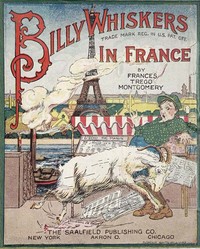
The book’s illustrations, by Florence White Williams, are not mere decorations but freeze key moments of physical comedy and danger. The frontispiece shows Billy running “straight on, regardless of bombs dropping all around me.” Other captions describe Billy butting a basket of clothes, jerking a cook around trees, and rolling over something that “squealed like a stuck pig.” These images emphasize the goat’s disruptive energy—he is a force of nature colliding with wartime order. The illustrations also highlight the absurdity: a goat upending a cook or a cat attacking spies. They ground the fantastical premise in visual slapstick, reinforcing the book’s tone of earnest adventure mixed with barnyard humor.
Readers should pay attention to how Montgomery balances the animals’ domestic instincts—Billy’s longing for Nannie, Button’s hunt for mice—with the larger war machinery. The excerpts suggest a world where farm animals are both victims and agents, their small-scale rebellions echoing the larger conflict. The incomplete text leaves questions: Does Billy make it home? Do the spies succeed? But the charm lies in the journey, not the destination.
Reading about Billy’s homesickness crossing that submarine-dark Atlantic reminded me of a different kind of longing — the boy in Guy Harris, the Runaway — A Closer Reading who runs toward freedom only to find he’s carrying home inside his own chest. Strange how war and running away both end in the same quiet ache.
There are no reviews for this eBook.
There are no comments for this eBook.
Reader reflection
How did this book work for you?
Your answers remain private and are stored only in this browser.
Your progress
0
/
10
2
How much did you enjoy the reading experience?
3
Would you pass this book on to a friend?
4
Did the language feel accessible?
5
Which element worked best for you?
6
Did the story or argument move comfortably?
7
Did the book offer a fresh perspective?
8
Did the book give you something worth debating?
9
What changed or sharpened your thinking?
10