1

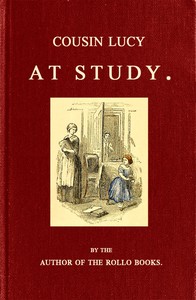
Cousin Lucy at Study By the Author of the Rollo Books — Inside the Classic
(0 User reviews)
883
Project Gutenberg
2022
Not confirmed
Siblings -- Juvenile fiction; Country life -- Juvenile fiction; Children with disabilities -- Juvenile fiction; Families -- Juvenile fiction; Parent and child -- Juvenile fiction; Money -- Juvenile fiction
Readers of public-domain and historical texts
Project Gutenberg digital edition
en
Edition facts
Words
36,657
Reading time
160 min
Text sections
18
This digital edition of Cousin Lucy at Study By the Author of the Rollo Books — Inside the Classic is described by source-level measurements including 36,657 words, 2 hr 40 min estimated reading time, and 18 detected text sections.
The text analysis averages about 17.1 words per sentence, while the detected sections provide another way to judge how the source is divided.
Project Gutenberg metadata also associates the work with “Siblings -- Juvenile fiction,” connecting these edition facts with the source record’s subject description.
Source:
Project Gutenberg record #67601
This editorial note examines how Jacob Abbott uses dialogue, moral commentary, and shifts in pace to shape Cousin Lucy at Study, a mid-19th-century children's book about a five-year-old girl learning lessons at home and in nature.
Editorial Edition Score
4.8/5
★★★★★
★★★★★
Calculated from edition completeness, EPUB availability, text structure and catalogue metadata. Not a user rating.
How this score is calculated
- Description quality20 pts
- Title & short description10 pts
- Source metadata20 pts
- Text length15 pts
- Chapters / structure15 pts
- EPUB file integrity20 pts
Total of 100 points, scaled to a 2.5-5.0 range. Editions with an empty description or a missing EPUB file are not scored.
Edition quality
Public-domain source text
Read the source text
The source text is kept in the dedicated reader, separate from this catalogue record and its commentary.
From its opening scene, Cousin Lucy at Study establishes a distinctive narrative rhythm: a domestic incident—Lucy receiving a new slate—unfolds in short, declarative sentences and rapid dialogue, then abruptly pauses for a paragraph of explicit moral judgment (“Royal did wrong”). This pattern of action followed by authorial commentary recurs throughout the excerpts, creating a didactic pulse that defines the book’s voice. Abbott’s prose moves between concrete, sensory description (the “thin, flat parcel,” the “broad and shallow sheet of water”) and abstract instruction, often within the same chapter. The result is a reading experience that oscillates between story and sermon, inviting young readers to observe behavior and then reflect on its rightness.
Dialogue as a Vehicle for Instruction
The excerpts are dominated by direct speech, much of it between Lucy and her brother Royal or the older girl Mary Jay. Abbott uses dialogue not merely to advance plot but to model conversational reasoning. When Royal tries to take Lucy’s parcel, the exchange is clipped and natural: “Let me open it for you, Lucy. I know how to open it.” / “No,” said Lucy, “I want to open it myself.” The author then steps in to label Royal’s action as wrong, but the dialogue itself already conveys the tension. Later, Mary Jay’s extended account of a teacher’s response to a student’s complaint is almost entirely in quoted speech, turning the lesson into a miniature play. Abbott’s dialogue often carries the moral weight, with characters stating principles explicitly: “You don’t go to school to do over again what you can already do very well.” This technique keeps instruction embedded in character interaction rather than abstract lecture.
Shifts in Pace: From Domestic Bustle to Quiet Observation
Abbott varies sentence length and scene duration to create distinct tempos. The opening chapter moves quickly: Lucy runs, opens a parcel, argues with Royal, and receives her slate in a few paragraphs. Then the pace slows as the narrative describes the slate’s “smooth, dark surface” and the “little wooden frame.” Later, when Lucy follows Mary Jay to a woodland pool, the prose expands into leisurely description: “a broad and shallow sheet of water, made by the expansion of a brook, which flowed here over smooth, yellow sands.” The waterfall, the overhanging trees, and the stone seat are rendered in unhurried detail. These pauses contrast with the brisk, conflict-driven dialogues, giving the reader breathing room and emphasizing the natural setting as a space for reflection. The shift is not arbitrary; it mirrors Lucy’s own transition from eager activity to attentive stillness.
Recurring Motifs: Objects, Money, and Measurement
Several concrete items recur across the excerpts, linking scenes and reinforcing themes. The new slate is the first object; later, a “little iron bar” and a “little hoe” appear in Mary Jay’s story of moving a stone. These tools emphasize practical problem-solving and physical effort. Money also surfaces: the catalog lists “Money -- Juvenile fiction,” and in the excerpts, Royal drives a chaise, parcels are bought in the city, and Mary Jay’s father buys her a hoe. The word “accounts” appears as a chapter title, suggesting that counting and value are woven into the narrative. Abbott uses these objects not as mere props but as anchors for lessons about patience, ownership, and skill. The stone seat, pried into place with ingenuity, becomes a symbol of what a child can achieve with persistence—a lesson conveyed through the object itself rather than through direct moralizing.
Readers will find that Cousin Lucy at Study rewards attention to its structural choices: the alternation of fast dialogue and slow description, the embedded moral commentary, and the careful placement of objects as teaching tools. Because the excerpts represent only a portion of the book, some developments—such as the full arc of Lucy’s relationship with Mary Jay or the resolution of the “Accounts” chapter—remain unknown. Approaching the text with an eye to its pacing and voice, rather than expecting a continuous plot, will best reveal Abbott’s craft.
I’ve watched Cousin Lucy at Study sit beside my desk for years, and its gentle patience with a five-year-old mind reminds me of another quiet soul—Fire in the Woods Illustrated — Context and Discussion. Both whisper, rather than shout, their lessons. One teaches listening to nature; the other, listening to oneself. They keep each other company on the shelf, like old friends sharing a hush.
There are no reviews for this eBook.
There are no comments for this eBook.
Reader reflection
Your personal reading reflection
Build a private reading journal entry for this title.
Your progress
0
/
10
2
What was your overall reaction to the book?
3
How likely are you to recommend this book?
4
What was the reading difficulty like?
5
How distinctive were its ideas or approach?
6
What was its emotional impact?
7
How useful were the ideas in this book?
8
Would you read this book again?
9
Which lesson or insight stayed with you?
10