1

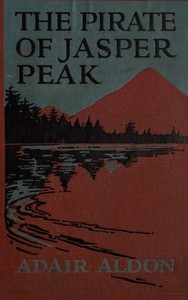
The Pirate of Jasper Peak — Background and Themes
(0 User reviews)
588
Project Gutenberg
2018
Not confirmed
Adventure stories; Teenage boys -- Juvenile fiction; Missing persons -- Juvenile fiction; Minnesota -- Juvenile fiction
Readers of public-domain and historical texts
Project Gutenberg digital edition
en
Edition facts
Words
49,045
Reading time
214 min
Text sections
12
For The Pirate of Jasper Peak — Background and Themes, the stored edition analysis reports 49,045 words, 3 hr 34 min estimated reading time, and 12 detected text sections.
The text analysis averages about 20.4 words per sentence, while the detected sections provide another way to judge how the source is divided.
Project Gutenberg metadata also associates the work with “Adventure stories,” connecting these edition facts with the source record’s subject description.
Source:
Project Gutenberg record #57918
Hugh Arnold arrives at Rudolm, Minnesota, expecting a winter of isolation. Instead, he encounters a mysterious figure on Jasper Peak, a missing neighbor, and the harsh realities of frontier life. Cornelia Meigs builds tension through contrasts: the train's speed versus the stillness of the lake, the comfort of home versus the wild forest, and the boy's inexperience versus the demands of survival.
Editorial Edition Score
4.7/5
★★★★★
★★★★★
Calculated from edition completeness, EPUB availability, text structure and catalogue metadata. Not a user rating.
How this score is calculated
- Description quality20 pts
- Title & short description10 pts
- Source metadata20 pts
- Text length15 pts
- Chapters / structure15 pts
- EPUB file integrity20 pts
Total of 100 points, scaled to a 2.5-5.0 range. Editions with an empty description or a missing EPUB file are not scored.
Edition quality
Public-domain source text
Read the source text
The source text is kept in the dedicated reader, separate from this catalogue record and its commentary.
The novel opens with a striking contrast: the long Pullman train, impatient and late, deposits Hugh Arnold at the tiny station of Rudolm. The porter's disbelief that anyone would stay the winter sets the tone for a story rooted in the tension between the familiar and the unknown. Hugh's first survey of Red Lake—described as a 'queer, crooked place, full of harbors and headlands and hidden coves'—immediately establishes the landscape as both beautiful and treacherous. The map had hinted at this complexity, but the reality proves more layered. Meigs uses the setting not merely as backdrop but as an active force, shaping every decision Hugh makes.
The Weight of a Single Day
The excerpts reveal how Meigs builds suspense through the accumulation of mundane tasks. Hugh's day alone at the cabin is a catalog of chores: cleaning pans, carrying water, clearing weeds from Oscar's garden, cutting wood for winter fuel. The narrative lingers on these actions—'He worked actively all afternoon, as much for the sake of keeping warm and occupied, as for what he might accomplish'—suggesting that survival itself is a kind of labor. The storm that rises as darkness falls amplifies the isolation. The wind 'whistling down the chimney' fills the room with smoke; the flooded stream roars louder. Each detail reinforces the precariousness of Hugh's position. The climax of this section is not a dramatic event but the milking of the cow, Hulda. Hugh's pride in achieving this task—'He felt prouder of having milked Hulda without assistance than of anything he had ever before achieved'—is both touching and telling. It is a small victory, but one that signals his gradual adaptation to a world that demands competence.
Voices in the Wilderness
Meigs populates her story with characters who speak in distinct registers, from the porter's colloquial warmth ('You-all will be going back with us to-morrow, I reckon') to Oscar's implied practicality. The dialogue is spare but effective. The porter's warning—'we go through every day at six in the morning less'n we're late'—echoes throughout the opening, a reminder of the outside world's indifference. Hugh's own voice is measured, often internal. When he speaks, it is to assert his intention to stay, a decision that others find incomprehensible. The contrast between his resolve and the porter's skepticism creates an early tension. Later, in the cabin, Hugh's muttered confidence to Hulda—'You are a good cow, Hulda; there are not many who would stand for what you have'—reveals a boy learning to find companionship in a creature. The absence of Oscar, the missing neighbor, is felt as a silence. The narrative never explains his disappearance in the excerpts, leaving the reader to wonder whether he will return or whether Hugh must face the winter alone.
The Unseen Presence of Jasper Peak
Jasper Peak itself is a constant, looming presence. Hugh looks across at it 'as he came out' of the cabin, but 'a curtain of rain was falling between him and the mountain.' The peak is never fully seen; it is obscured, distant, yet central to the story's title. This visual barrier mirrors the larger mystery: something is happening on that mountain, but Hugh cannot yet perceive it. The narrative withholds information, building anticipation through what is not shown. The 'cabin opposite' is 'invisible' in the rain, suggesting a neighbor who may or may not be trustworthy. Meigs uses the landscape to create a sense of hidden danger. The mountain is not just a geographical feature but a symbol of the unknown. The reader, like Hugh, is left to speculate about what lurks beyond the curtain of rain. This technique—revealing through concealment—is a hallmark of the novel's structure, as the excerpts hint at a larger conflict without fully disclosing it.
Readers should pay close attention to the small details: the way Hugh stacks wood, the sound of the wind, the quality of the light. Meigs builds her story not through grand set pieces but through the accumulation of sensory impressions. The mystery of Jasper Peak is woven into the fabric of daily life, and the novel's power lies in how it makes the ordinary feel charged with significance. Approach this as a study in atmosphere and character, where every action carries weight and every silence speaks.
That stillness in the frontier—the way isolation sharpens every detail—has lingered with me since this one. It made me think of a quiet book about the Australian outback, where a girl’s world feels just as vast and lonely. The Little Black Princess: A True Tale of Life in the Never-Never Land — Background and Themes carries that same soft ache of place.
There are no reviews for this eBook.
There are no comments for this eBook.
Reader reflection
Take a moment to reflect on this book
Create a short personal record of your experience with this book.
Your progress
0
/
10
2
How did the book work for you overall?
3
How likely are you to recommend this book?
4
Did the language feel accessible?
5
Would you read this book again?
6
How useful did the reading feel?
7
Did this book create an emotional response?
8
How closely did the book connect with your experience?
9
What is the main idea you are taking away?
10