1

A Butterfly Chase — Themes and Context
(0 User reviews)
214
Project Gutenberg
2017
Not confirmed
Animal welfare -- Juvenile fiction; Country life -- Juvenile fiction; Cousins -- Juvenile fiction; Donkeys -- Juvenile fiction; Butterflies -- Collection and Preservation -- Juvenile fiction
Readers of public-domain and historical texts
Project Gutenberg digital edition
en
Edition facts
Words
6,233
Reading time
28 min
Text sections
24
The catalog record for A Butterfly Chase — Themes and Context provides practical reading context through 6,233 words, 28 min estimated reading time, and 24 detected text sections.
The text analysis averages about 19.1 words per sentence, while the detected sections provide another way to judge how the source is divided.
Project Gutenberg metadata also associates the work with “Animal welfare -- Juvenile fiction,” connecting these edition facts with the source record’s subject description.
Source:
Project Gutenberg record #54725
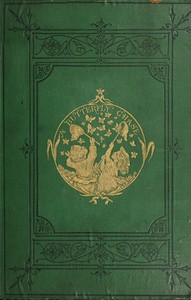
In this 1869 translation of P.-J. Stahl's French children's story, young Minnie and Bertie set out to collect butterflies but reconsider after a live butterfly's escape prompts a change of heart. The narrative contrasts scientific enthusiasm with animal welfare, as illustrated by Lorenz Frølich.
Editorial Edition Score
4.7/5
★★★★★
★★★★★
Calculated from edition completeness, EPUB availability, text structure and catalogue metadata. Not a user rating.
How this score is calculated
- Description quality20 pts
- Title & short description10 pts
- Source metadata20 pts
- Text length15 pts
- Chapters / structure15 pts
- EPUB file integrity20 pts
Total of 100 points, scaled to a 2.5-5.0 range. Editions with an empty description or a missing EPUB file are not scored.
Edition quality
Public-domain source text
Read the source text
The source text is kept in the dedicated reader, separate from this catalogue record and its commentary.
The story opens with Minnie and her cousin Bertie fully equipped for butterfly collecting: nets, a case of steel instruments, pins, and glass squares to hold specimens flat. Their uncle, a museum professor, has sent a book with colored pictures and names of butterflies. The children are eager to begin.
Yet from the start, Minnie's mother hesitates. She is "not quite pleased" with the nets and "sharp, dreadful-looking steel things." She would rather the children learn by watching live butterflies than by killing them. This tension between scientific collection and compassion sets up the story's central conflict.
The Mother's Quiet Resistance
Minnie's mother is the only adult whose perspective is shown in the excerpts. She does not forbid the chase but "shook her head rather sadly" at the equipment. Her concern is not stated as a rule but as a feeling: she would prefer the children learn from watching butterflies "flying about, and settling on the flowers." The narrator notes she does not want to vex the learned uncle, who is "always thinking of collections and museums." This places her as a gentle counterpoint to the uncle's scientific authority.
The mother's later appearance near the end reinforces her role. She sees the children fall into a ditch and hurries to them, but finds them already changed. She promises to explain later that only learned men should make "painful experiments" for useful knowledge; others should not destroy creatures wantonly. Her voice frames the moral without imposing it prematurely.
A Butterfly's Escape Reverses the Chase
The turning point occurs when Bertie catches a butterfly. Minnie suddenly objects: she has read in their uncle's book that butterflies "live for several days with pins run through them." She calls it "dreadful" and says killing things is "not nice play." Bertie lifts his net, and the butterfly flies free. Minnie throws her arms around him, and they decide never to chase butterflies again.
This moment is the story's only action scene involving a butterfly. The children's change of heart is immediate and mutual. The narrator emphasizes their happiness at having "done right." The chase is abandoned not by adult intervention but by the children's own empathy after a single catch.
The Donkey and the Unseen Uncle
Two characters remain peripheral but suggestive. The uncle never appears; he is known only through his gifts and his reputation as "a very learned man." His book and equipment set the plot in motion, but his views are never directly challenged. The mother's reluctance is directed at his methods, not at him personally.
The donkey appears in the final chapter as a comic observer. After the children fall into a ditch, the narrator says, "I don't know what has become of him. I think he has given up trying to understand anything about the matter, and gone home to his stable." This deadpan aside lightens the moral weight and reminds readers that the story is, after all, a children's tale with room for humor.
The excerpts show a story that balances a clear moral with concrete details: the specific equipment, the mother's silent disapproval, and the children's sudden reversal. Readers may note how the uncle's scientific authority is never rebutted, only set aside. The donkey's exit offers a wry note that undercuts any heavy-handed lesson. This edition, translated from French and illustrated by Lorenz Frølich, preserves the original 1869 text with its period vocabulary and sentence structure.
Sometimes a story stays because it doesn’t rush its quiet honesty, like Minnie and Bertie learning to see the butterfly differently. That same gentle shift—where wonder softens into care—echoes in The Strange Likeness — Key Ideas to Explore, and I found myself pausing there, mid-thought, remembering how change can arrive so tenderly.
There are no reviews for this eBook.
There are no comments for this eBook.
Reader reflection
What did you think of this book?
Answer a few questions and save a private reflection on this device.
Your progress
0
/
10
2
Did this book hold your interest?
3
How likely are you to recommend this book?
4
What was the reading difficulty like?
5
Did the book offer a fresh perspective?
6
Did the story or argument move comfortably?
7
How much did the book move you?
8
Did you relate to its people, ideas, or situations?
9
In one sentence, what did you learn?
10