1

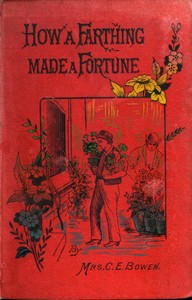
How a Farthing Made a Fortune; or "Honesty is the best policy" — Reading Notes
(0 User reviews)
418
Project Gutenberg
2017
Not confirmed
Christian life -- Juvenile fiction; Honesty -- Juvenile fiction; Kindness -- Juvenile fiction; Poverty -- Juvenile fiction; Children -- Religious life -- Juvenile fiction; Theft -- Juvenile fiction
Readers of public-domain and historical texts
Project Gutenberg digital edition
en
Edition facts
Words
25,965
Reading time
113 min
Text sections
4
This digital edition of How a Farthing Made a Fortune; or "Honesty is the best policy" — Reading Notes is described by source-level measurements including 25,965 words, 1 hr 53 min estimated reading time, and 4 detected text sections.
The text analysis averages about 15.7 words per sentence, while the detected sections provide another way to judge how the source is divided.
Project Gutenberg metadata also associates the work with “Christian life -- Juvenile fiction,” connecting these edition facts with the source record’s subject description.
Source:
Project Gutenberg record #54961
Examines how C. E. Bowen uses precise diction, contrasting settings, and embedded moral lessons to dramatize honesty and kindness in a Victorian children's story about a poor London boy.
Editorial Edition Score
4.6/5
★★★★★
★★★★★
Calculated from edition completeness, EPUB availability, text structure and catalogue metadata. Not a user rating.
How this score is calculated
- Description quality20 pts
- Title & short description10 pts
- Source metadata20 pts
- Text length15 pts
- Chapters / structure15 pts
- EPUB file integrity20 pts
Total of 100 points, scaled to a 2.5-5.0 range. Editions with an empty description or a missing EPUB file are not scored.
Edition quality
Public-domain source text
Read the source text
The source text is kept in the dedicated reader, separate from this catalogue record and its commentary.
From its first sentence, How a Farthing Made a Fortune establishes a stark contrast between the reader's likely experience and the squalor of Roan's Court, where Dick Nason lives. Bowen describes cellar rooms with windows 'stuffed up with dirty rags or paper,' a detail that grounds the narrative in specific, material poverty rather than abstract hardship. The author's choice to open with a direct address—'Few children, if any, who read this tale will probably be able to form any idea'—signals an instructional intent, but the vivid description of 'haunts of iniquity and misery' gives the moral framework a concrete foundation.
Diction of Deprivation
Bowen's vocabulary for poverty is deliberately unsparing. The Nasons' home is a 'cellar room' with windows 'begrimed with dirt'; the family 'scrambled on in a wretched way.' These phrases avoid sentimentality, instead using physical details—rags, broken glass, a sunken floor—to convey degradation. The word 'scrambled' suggests animalistic survival, while 'wretched' recurs as a blunt descriptor. This lexical choice positions the reader to see deprivation as a condition to be escaped through moral reform, not merely pitied.
Dialogue as Moral Instruction
The conversation between Dick and Walters reveals Bowen's method of embedding ethics in dialogue. Walters quotes scripture—'Do good to them that hate you'—and then offers a practical application: 'say a prayer for him now and then.' The exchange is naturalistic in its back-and-forth, but the didactic purpose is clear. Walters' story about James Bennett, told in a colloquial yet measured voice, functions as a parable within the narrative. Bowen uses Walters' direct speech to model how moral lessons are transmitted orally, mirroring the book's own instructional role.
Structure of Contrast
The book's chapters move from Roan's Court to Denham Court, a shift Bowen emphasizes through descriptive contrast. The cellar's 'four small panes of glass' give way to the lodge's 'little parlour' with a fireside. This spatial progression mirrors Dick's moral journey. Bowen also contrasts characters: the ragman father who 'spent so much in drink' versus Walters, who keeps a Bible 'never far from his hand.' These structural oppositions reinforce the theme that environment and influence shape character, a premise the narrative tests through Dick's choices.
Recurring Motif of the Farthing
The farthing of the title is not merely a plot device but a recurring symbol of small, honest actions. Bowen returns to it at key moments, linking the coin to the proverb 'Honesty is the best policy.' The motif appears in the opening chapters and is echoed in Walters' tale of lost opportunity due to deceit. By making a single coin the fulcrum of fortune, Bowen suggests that moral decisions, however minor, have cumulative consequences. This motif gives the story a tangible anchor for its abstract lesson.
Readers attentive to Bowen's authorial choices will notice how she balances realism with moral design. The precise descriptions of London slums and the careful construction of dialogue as instruction reveal a writer who trusted concrete detail to carry her lesson. The farthing itself—a coin worth a quarter of a penny—becomes a measure of character. This edition invites scrutiny of how Bowen's diction and structure work together to make honesty not just a policy but a plot.
Reading this brought back a stifling Sunday afternoon, the coal fire low, and me puzzling over a borrowed penny I’d found and returned. The quiet thrill of that small, honest act felt enormous. Little Homespun — Reading Notes held a similar warmth, a gentle reminder that goodness often whispers rather than shouts, leaving a soft, lasting echo.
There are no reviews for this eBook.
There are no comments for this eBook.
Reader reflection
How will you remember this book?
Save your reaction, strongest insight, and memorable passage.
Your progress
0
/
10
2
How did the book work for you overall?
3
Is this a title you would suggest to others?
4
How demanding did the text feel?
5
Did the book offer a fresh perspective?
6
Did the book deliver what you hoped for?
7
What was its emotional impact?
8
Did it raise ideas you would like to talk about?
9
In one sentence, what did you learn?
10