1

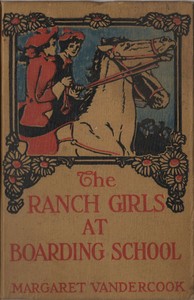
The Ranch Girls at Boarding School — Reading Companion
(0 User reviews)
79
Project Gutenberg
2017
Not confirmed
Schools -- Juvenile fiction; Friendship -- Juvenile fiction; Girls -- Juvenile fiction; Boarding school students -- Juvenile fiction; Young women -- Social life and customs -- Juvenile fiction; Hudson River Valley (N.Y. and N.J.) -- Social life and customs -- Juvenile fiction
Readers of public-domain and historical texts
Project Gutenberg digital edition
en
Edition facts
Words
60,264
Reading time
263 min
Text sections
5
The catalog record for The Ranch Girls at Boarding School — Reading Companion provides practical reading context through 60,264 words, 4 hr 23 min estimated reading time, and 5 detected text sections.
The text analysis averages about 25.6 words per sentence, while the detected sections provide another way to judge how the source is divided.
Project Gutenberg metadata also associates the work with “Schools -- Juvenile fiction,” connecting these edition facts with the source record’s subject description.
Source:
Project Gutenberg record #56097
An editorial note examining the narrative voice and pacing in Margaret Vandercook's 1913 boarding-school novel, focusing on the opening's restless interiority, the use of scriptural quotation for emotional weight, and the shift to dialogue-driven conflict in later excerpts.
Editorial Edition Score
4.7/5
★★★★★
★★★★★
Calculated from edition completeness, EPUB availability, text structure and catalogue metadata. Not a user rating.
How this score is calculated
- Description quality20 pts
- Title & short description10 pts
- Source metadata20 pts
- Text length15 pts
- Chapters / structure15 pts
- EPUB file integrity20 pts
Total of 100 points, scaled to a 2.5-5.0 range. Editions with an empty description or a missing EPUB file are not scored.
Edition quality
Public-domain source text
Read the source text
The source text is kept in the dedicated reader, separate from this catalogue record and its commentary.
The novel begins not with arrival or introduction but with a single wakeful figure measuring time by a distant clock. Olive Ralston, alone in the dark, murmurs verses from the Psalms as if they were a private incantation against homesickness. The prose slows to match her vigil: sentences crawl through the small hours, and the description of her “slim ghost” crossing the floor—with “two shadowy lengths of jet-black hair”—is the first concrete image. This opening establishes a voice that is both intimate and slightly formal, willing to pause for interior reflection before the school story proper begins.
A Restless Opening and the Weight of Scripture
The first chapter, titled “Still as the Night,” devotes several paragraphs to a single character’s sleeplessness. Olive recites Psalm 11 verbatim, then breaks off to whisper to her sleeping roommates. The pacing is deliberately slow: the narrative lingers on her vigil, on the “five minutes” that crawl by, on the physical sensation of kneeling beside another bed. This is not a brisk, plot-driven start. Instead, Vandercook uses the stillness to establish Olive’s emotional state—homesick, lonely, desperate—before any action occurs. The scriptural quotation is not merely decorative; it functions as a kind of internal monologue, a prayer that reveals her anxiety. The effect is to make the reader share her impatience for morning, for company, for the story to begin.
Shifts in Pace: From Interior Vigil to Dialogue
Later excerpts show a marked change in tempo. The prose becomes brisk and conversational, dominated by quick exchanges and overlapping voices. In the scene where Olive confronts Jean about joining the Theta Society, the paragraphs shorten, and the dialogue carries the weight of the conflict. Jean’s reply—“I knew, Olive, from the first that you were going to ask me something I could not grant”—is delivered with a lightness that contrasts sharply with the opening’s gravity. The narrative now moves through argument, persuasion, and a brief moment of physical tableau (the two girls with hands on each other’s shoulders). The shift is not abrupt but noticeable: the same characters who were once silent and still are now voluble and active. This change in pace mirrors the transition from private anxiety to social negotiation, a central tension in boarding-school fiction.
Voice and the Use of Direct Address
Throughout the excerpts, Vandercook employs direct address and interjections to create a sense of immediacy. Olive’s whispered “Oh, girls, are you awake yet?” and Jean’s plaintive “Has any one in this world ever heard of a goose who chose to be one?” give the narrative a spoken quality, as if the characters are confiding in the reader. The narrator also steps in with phrases like “her listeners could not help smiling,” which acknowledge an audience within the scene. This technique keeps the voice close to the characters’ perspectives, even when the prose shifts to third-person. The effect is to make the reader feel present in the room, overhearing the arguments and the laughter. The voice is not omniscient or distant; it is tuned to the rhythms of conversation and the small gestures—a hand on an arm, a look flashed—that define the social world of Primrose Hall.
Readers attentive to pacing will notice how Vandercook alternates between slow, reflective passages and rapid, dialogue-driven scenes. The opening’s stillness is not repeated in the later excerpts; instead, the novel builds momentum through conversation and conflict. Pay attention to how the narrative voice shifts between Olive’s interiority and the group’s collective energy. The book rewards a focus on these modulations, which give texture to what might otherwise be a straightforward school story.
There’s something tender about how Vandercook lets her girls think in spirals before they speak, those early restless pages feeling like a diary left open. I catch that same quiet ache in the canoe trip companion—not the plot, but the way silence does the heavy lifting. The Girl Scouts’ Canoe Trip — Reading Companion lingers in my mind the way boarding-school corridors did, half-lit and humming.
There are no reviews for this eBook.
There are no comments for this eBook.
Reader reflection
Your personal reading reflection
Build a private reading journal entry for this title.
Your progress
0
/
10
2
How much did you enjoy the reading experience?
3
Would you encourage someone else to read it?
4
What was the reading difficulty like?
5
What was the strongest part of the book?
6
Did the story or argument move comfortably?
7
Is this a title worth rereading?
8
Would you like to discuss this book with someone?
9
In one sentence, what did you learn?
10