1

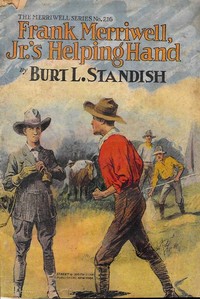
Frank Merriwell, Jr.'s, Helping Hand; Or, Fair Play and No Favors — Edition Insights
(0 User reviews)
757
Project Gutenberg
2020
Not confirmed
Adventure stories; Dime novels; Arizona -- Juvenile fiction; Merriwell, Frank, Jr. (Fictitious character) -- Juvenile fiction
Readers of public-domain and historical texts
Project Gutenberg digital edition
en
Edition facts
Words
93,535
Reading time
407 min
Text sections
50
The catalog record for Frank Merriwell, Jr.'s, Helping Hand; Or, Fair Play and No Favors — Edition Insights provides practical reading context through 93,535 words, 6 hr 47 min estimated reading time, and 50 detected text sections.
The text analysis averages about 14.9 words per sentence, while the detected sections provide another way to judge how the source is divided.
Project Gutenberg metadata also associates the work with “Adventure stories,” connecting these edition facts with the source record’s subject description.
Source:
Project Gutenberg record #62421
This editorial note examines the structure and recurring imagery in Burt L. Standish's Frank Merriwell, Jr.'s, Helping Hand, focusing on how the narrative moves between tense confrontations and moral stands, using the desert setting and animal cruelty as a catalyst for action.
Editorial Edition Score
4.9/5
★★★★★
★★★★★
Calculated from edition completeness, EPUB availability, text structure and catalogue metadata. Not a user rating.
How this score is calculated
- Description quality20 pts
- Title & short description10 pts
- Source metadata20 pts
- Text length15 pts
- Chapters / structure15 pts
- EPUB file integrity20 pts
Total of 100 points, scaled to a 2.5-5.0 range. Editions with an empty description or a missing EPUB file are not scored.
Edition quality
Public-domain source text
Read the source text
The source text is kept in the dedicated reader, separate from this catalogue record and its commentary.
The opening chapters of Frank Merriwell, Jr.'s, Helping Hand establish a pattern of swift, morally charged confrontations set against the stark Arizona landscape. The narrative moves rapidly from a quiet observation behind rocks to a violent intervention, as Merriwell and Clancy disrupt Jode Lenning's torture of a tramp dog. This scene, drawn from the excerpts, exemplifies the book's structural reliance on sudden shifts from hidden watching to decisive action, a technique that propels the dime-novel pacing.
Concealment and Revelation
The excerpts repeatedly position characters behind rocks or ridges, observing before acting. Merriwell and Clancy “sank down behind the rocks” to watch Lenning’s group, and later emerge “with a rush” to intervene. This pattern of concealment followed by revelation creates a rhythm of tension and release. The desert terrain itself becomes a stage for moral scrutiny: the hidden vantage point allows the reader to judge the antagonists’ cruelty before the heroes step forward. Standish uses this structural device to build suspense while reinforcing the theme of fair play—the heroes see the wrongdoing clearly before they act.
The Dynamite and the Dog
A vivid recurring image is the dynamite cartridge tied to the dog’s tail, a threat that literalizes the danger of unchecked cruelty. The fuse, the match, the “blazing match” knocked from Lamson’s fingers—these details recur with mechanical precision. The dog, described as a “tramp dog” and a “ki-yi,” is both a victim and a symbol of the lawless frontier that Lenning represents. Standish does not linger on the animal’s suffering; instead, he uses the object (the dynamite) to heighten the stakes of the confrontation. The image returns in dialogue, as Lenning sneers about “putting him out of business,” tying the physical threat to the moral conflict.
Movement Between Camps
The narrative moves between two opposing camps: Lenning’s group, described as a “community of interest” with “no real friendship,” and Merriwell’s camp, which operates on loyalty and principle. The excerpts show Merriwell and Clancy traveling “from Tinaja Wells with an olive branch,” a phrase that ironically frames their intervention as a peace offering. This geographical movement—from one camp to another—mirrors the moral journey of the story. The desert setting is not just backdrop but a space where these opposing values collide. Standish uses the physical distance between camps to create a sense of frontier justice, where help must travel to reach those in need.
Voice and Moral Certainty
Merriwell’s speech in the excerpts is marked by a blend of restraint and steel: “You’d better cut away that dynamite cartridge and let the brute go.” The narrator notes that his voice is “like velvet, yet it cut like steel.” This duality defines the hero’s voice—calm but unyielding. In contrast, Lenning’s dialogue is full of sneers and threats: “You’re a private little society for the prevention of cruelty to coyote dogs, eh?” The moral certainty is reinforced by the narrator’s commentary, which labels the antagonists “skunks” and “cannibals.” This directness is characteristic of the dime-novel style, leaving no ambiguity about who deserves the reader’s sympathy.
Readers approaching Frank Merriwell, Jr.'s, Helping Hand will find a narrative built on rapid scene shifts and vivid moral contrasts. Pay attention to how Standish uses the desert landscape—rocks, camps, distances—to frame each confrontation. The recurring image of the dynamite-laden dog is not just a plot device but a measure of the antagonists’ depravity. The book rewards those who track these structural patterns, as they reveal the craft beneath the adventure.
I’ve spent long afternoons with Standish’s desert tests, where a boy’s helping hand is never quite enough without the fair-play heart behind it. That same quiet longing seems to hum through The Wishing Cap — A Reader’s Guide, another volume I keep close, wondering if wishes ever truly mend the spaces between us. They both feel like old friends—waiting patiently for me to return.
There are no reviews for this eBook.
There are no comments for this eBook.
Reader reflection
What did you think of this book?
Answer a few questions and save a private reflection on this device.
Your progress
0
/
10
2
Did this book hold your interest?
3
Would you encourage someone else to read it?
4
What was the reading difficulty like?
5
Did the book offer a fresh perspective?
6
What did you appreciate most?
7
Did it raise ideas you would like to talk about?
8
How did the pace of the book feel?
9
What is the main idea you are taking away?
10