1

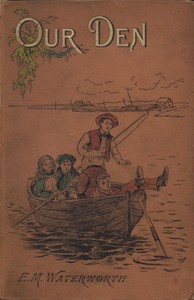
Our Den — Inside the Classic
(0 User reviews)
319
Project Gutenberg
2019
Not confirmed
Conduct of life -- Juvenile fiction; Children -- Conduct of life -- Juvenile fiction; Boys -- Juvenile fiction; Brothers -- Juvenile fiction; Cousins -- Juvenile fiction; Inheritance and succession -- Juvenile fiction; Wills -- Juvenile fiction; Ghosts -- Juvenile fiction
Readers of public-domain and historical texts
Project Gutenberg digital edition
en
Edition facts
Words
18,669
Reading time
82 min
Text sections
2
For Our Den — Inside the Classic, the stored edition analysis reports 18,669 words, 1 hr 22 min estimated reading time, and 2 detected text sections.
The text analysis averages about 17.5 words per sentence, while the detected sections provide another way to judge how the source is divided.
Project Gutenberg metadata also associates the work with “Conduct of life -- Juvenile fiction,” connecting these edition facts with the source record’s subject description.
Source:
Project Gutenberg record #59872
In E. M. Waterworth's Our Den, cousins turn a seaside attic into a refuge, but the story's real focus is Edric, a boy with a spinal curvature who gradually gains mobility and voice. The catalog subjects emphasize conduct and inheritance, yet the excerpts show a quieter drama of physical limitation and growing independence.
Editorial Edition Score
4.5/5
★★★★★
★★★★★
Calculated from edition completeness, EPUB availability, text structure and catalogue metadata. Not a user rating.
How this score is calculated
- Description quality20 pts
- Title & short description10 pts
- Source metadata20 pts
- Text length15 pts
- Chapters / structure15 pts
- EPUB file integrity20 pts
Total of 100 points, scaled to a 2.5-5.0 range. Editions with an empty description or a missing EPUB file are not scored.
Edition quality
Public-domain source text
Read the source text
The source text is kept in the dedicated reader, separate from this catalogue record and its commentary.
Our Den opens not with the den itself but with a domestic argument about whether to host a group of cousins. Edric, the narrator, lies on a sofa reading while his parents debate; his father calls the expected children 'young savages' and his mother counters with a doctor's advice that play with siblings might strengthen their only son. The exchange reveals Edric's condition—a spinal curvature from a fall, an iron frame he wore for two years, and a resulting inertia that has left him carried from room to room, 'quietly content.' The catalog subjects list 'Conduct of life' and 'Inheritance and succession,' but the opening chapters dwell on Edric's fragile body and his parents' protective worry.
A Boy Who Rarely Moves
Edric's physical state is established through small, precise details. He reads 'as I generally was in those days,' and his mother's 'anxious look' tells him she is not satisfied with his stillness. The London physician's report—that Edric would 'have more chance of getting strong if he had plenty of play with brothers and sisters'—is mentioned only in dialogue, not narrated directly. Edric himself admits he 'did not know what was the matter then' but knew he was 'not like other children.' The story does not describe his disability in clinical terms; instead, it shows his dread of noise and his parents' reluctance to urge him to walk. This restraint gives the early chapters a hushed, indoor quality that contrasts with the boisterous cousins who soon arrive.
The Den as a Place of Negotiation
The cousins—Rupert, Harold, Jack, and Kathleen—turn an attic into a den, but the excerpts show the space functioning less as a hideout and more as a stage for Edric's gradual engagement. When Jack injures his foot and hops about 'like a wounded stork,' Edric remarks, 'I might as well try to get about—I believe I should do it as well.' The den contains an oak chest that becomes a carpenter's bench and a source of mystery; Jack's curiosity about its contents leads to a secret he shares with Harold, with consequences that are only hinted at. The catalog subject 'Ghosts' appears in the chapter titles ('The Mysterious Visitor,' 'The Mystery Deepens'), but the excerpts focus on the chest and the cousins' carpentry, not on supernatural events.
Voice and Silence in the Narrative
Edric narrates in first person, but his voice is often passive. He listens to his parents argue, watches his cousins, and only rarely asserts himself. When he finally cries and begs for Kathleen to stay, his parents are surprised—'I haven't seen any tears since the invasion of the Goths and Vandals,' his father says. The narrative withholds Edric's interior reactions to his own disability; he reports the doctor's words only as overheard dialogue. This indirectness makes his rare emotional outbursts stand out. The catalog subject 'Conduct of life' might suggest moral lessons, but the excerpts show a boy learning to want things—to move, to speak up, to keep a secret—rather than being taught proper behavior.
Readers should attend to what Edric does not say. His silences, his parents' anxious glances, and the cousins' boisterous energy all circle around his unspoken struggle to reclaim his body. The den and the oak chest are props; the real mystery is how a boy who has been 'quietly content' begins to want to join the game. The catalog subjects list wills and ghosts, but the excerpts suggest the inheritance at stake is Edric's own agency.
There’s a moment in Our Den when Edric’s voice finally carries over the tide, and I still think about how quietly that arrives—no fanfare, just a breath taken. It makes me wonder about other stories where the hidden work is the whole work. I found a similar patience in Billy To-morrow — Edition Insights, and it stayed with me like a tide line.
There are no reviews for this eBook.
There are no comments for this eBook.
Reader reflection
Take a moment to reflect on this book
Create a short personal record of your experience with this book.
Your progress
0
/
10
2
How much did you enjoy the reading experience?
3
Would you pass this book on to a friend?
4
How much effort did this book require?
5
Did it raise ideas you would like to talk about?
6
How clearly were the main ideas presented?
7
Did the book deliver what you hoped for?
8
How much did the book move you?
9
What changed or sharpened your thinking?
10